
Free U.S. Shipping on Qualifying Subscriptions
•

90 Day Money-Back Guarantee


If you’ve ever gone to the drugstore to try on reading glasses and been frustrated because while a pair works really well for one eye, it just doesn’t help the other, you’re not alone. Many people suffer from mismatched eyes, and not in the exterior, visible sense.
When we talk about mismatched eyes, we’re talking about something much deeper that can affect our vision. Mismatched eyes, or aniseikonia, is a condition that literally translates from Greek as “unequal images.”
Are your eyes seeing unequal images? Here’s what you can do to solve this problem.
Aniseikonia is a condition where the eyes are seeing the same image differently. This puts our binocular vision at risk.
When someone has aniseikonia, it means that the eyes aren’t working together. If we only had one eye, this would not be a problem because the one eye would send our brain all the information it needs to create a coherent image.
However, when our two eyes fail to work together, it can severely affect our vision. When the brain is receiving similar images of the same object but at different depths, it can produce a muddled and unclear image.
Generally, aniseikonia is a direct result of eyeglasses. Many people need specially-made prescription eyeglasses to correct their vision. However, aniseikonia can develop when patients require two different prescriptions for each eye.
Eyeglasses are designed with monocular vision in mind, which hardly makes sense as humans clearly have two eyes, making our vision binocular. Working to establish monocular vision, eyeglass companies work to correct the vision in each eye. Still, they pay no attention to how that will affect the two eyes’ ability to work together.
Typical eyeglasses will make your vision clear in each eye, but they will also cause the eyes to see things in different sizes. You can imagine just how confusing it is for your brain. Next time you put on your glasses and find that your vision is off, it may not just be your imagination.
Similarly, patients who have undergone surgery to correct their refractive errors may also develop aniseikonia. In their case, however, the issue isn’t resolved as easily as taking the prescription glasses off.
Someone with aniseikonia will most likely experience double vision. Where they once had blurred vision, they will now see the world as if they were watching a 3-D movie without 3-D glasses. (As an aside, 3-D movies may actually be a good way to test your vision!).
Aniseikonia is separated into two types: static and dynamic.
Static aniseikonia is the most common type of aniseikonia caused by eyeglasses. If you have this type of aniseikonia, it means that while your eyes are gazing in the same direction, the size of the image as a whole is different in each eye.
Someone with dynamic aniseikonia on the other hand will have the eyes tracking the same image at different rates, thus affecting how the image is being transmitted to the brain.
Prescription eyeglasses or contact lenses that work with monocular vision cause both of these types of aniseikonia. While the eyes act differently under the different types of aniseikonia, the result is the same: double vision.
Corrective eyewear should do just that: correct. What’s the point of spending money on corrective eyewear if it’s only going to make your vision worse and cause more complications?
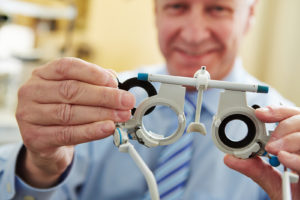 Ironically, the symptoms associated with both types of aniseikonia are the same as those associated with wearing the wrong prescription of glasses or when you strain and force your uncorrected eyes to see things they can’t see without correction.
The most common symptoms include:
These symptoms can put a damper on your everyday life, from affecting your performance at work to not being able to enjoy your favorite activities. Not having accurate depth perception can also put you in danger.
Testing for aniseikonia can be difficult as no one can see what you see with both eyes besides yourself. The best you can do is describe your symptoms and the images you’re seeing to your doctor.
Doctors commonly diagnose aniseikonia by asking patients to compare the two images that are being transmitted by the eyes. To do this, a patient will be asked to look through red and green glasses at a computer screen. Using a series of images, they will be asked to identify which green or red “I” shaped bar appears to be bigger.
Because one lens will be red and the other green, each eye is only seeing one bar, but it will look like two when the brain puts the images together. Your doctor will compare the results to properly diagnose you.
It may seem backward, but in order to treat a condition caused by faulty eyewear, you’ll need to replace it with more eyewear. Either way, your vision needs correcting. The refractive errors won’t disappear.
You need to find a pair of lenses that take binocular vision into account. These lenses need to not only correct refractive errors but also make sure that the eyes are working together and not seeing different images.
Luckily, a new lens design, courtesy of Dr. Peter Shaw, corrects your refractive errors and solves any aniseikonia problems. These lenses, called the SHAW Lens, are the result of hours and hours of research and strenuous math equations.
Dr. Shaw’s hard work paid off. He created a lens that can give everyone the vision they deserve.
If you’re tired of wearing those glasses everywhere you go, you may want to look into some alternative ways to get rid of those reading glasses.
Some popular treatments include vision therapy and eye exercises. Eye exercises work by strengthening the muscles surrounding and in your eye. They’re safe and natural ways to improve your vision. Just 10 minutes a day can make a world of difference.
Don’t get caught in the monocular vision trap. Find lenses that will support your binocular vision, not hinder it.
Tyler Sorensen is the President and CEO of Rebuild Your Vision. After graduating top of his class with a Bachelor of Science in Informational Technologies and Administrative Management, he joined Rebuild Your Vision in 2002. With the guidance of many eye care professionals — including Behavioral Optometrists, Optometrists (O.D.) and Ophthalmologists (Eye M.D.) — Tyler has spent nearly two decades studying the inner workings of the eye and conducting research.



Helping people protect their vision since 2002.

Jody Ayres says:
Thanks! I finally have a word for how I feel when I wear glasses. It’s been hard to describe that I see images at different sizes and it makes me feel off-balanced. It’s much better when I don’t wear glasses so I just wear them while driving