
All About Crossed Eyes and Lazy Eye
Crossed eyes and lazy eye are two of the most easily recognizable eye conditions. These issues are mostly found in children; however, when left untreated, they can become a permanent condition in adult eyes, impacting both how you look and how you see.
Because these conditions appear similarly, some people have a hard time telling them apart. After all, both crossed eyes and lazy eye affect the eye muscles and even cause similar symptoms. So, what’s the difference? And is it even important?
As you have probably guessed, the answer to that question is yes! Knowing which condition you or your child has will definitely impact how it is treated. Knowledge is power, and knowing the differences between these common eye conditions and how they might be treated can help you prepare in case you or a loved one is diagnosed as cross-eyed.
Strabismus (Crossed Eyes)
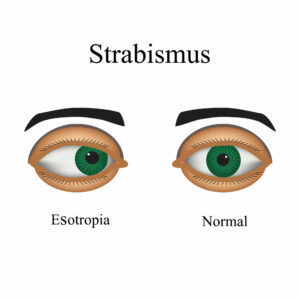
Strabismus is the medical term for cross-eyed. However, classifying the condition isn’t quite that simple. That’s because, at its most technical level, strabismus just means that the eyes are turned. This means that you could also say that someone with a lazy eye has strabismus, because one of their eyes is turned.
However, most of the time, when we use the term strabismus, we mean that someone looks “classically” cross-eyed: their eyes turn inward, toward the nose. The more technical term for this is actually esotropia. Conversely, someone whose eyes rotate outward would be diagnosed with exotropia. A person with exotropia would look like they are the opposite of cross-eyed. However, both conditions fall under the umbrella of strabismus.
The bottom line is that having crossed eyes doesn’t always mean they look crossed. In fact, some crossed eyes drift in completely different directions. One could be pointed up while the other one points down.
Symptoms and Causes of Strabismus
It’s fairly easy to spot symptoms of strabismus because they are so visible: if a person looks like they have misaligned eyes, they probably have some form of strabismus. A cross-eyed person may have eyes that drift inward, outward, or maybe in completely different directions.
So, what causes someone to develop crossed eyes? Many babies are born cross-eyed but then grow out of it on their own as their eyes finish developing. However, some babies don’t grow out of it without a little help. Childhood strabismus often needs to be treated by a professional. It’s much easier to treat these types of conditions early in life before the eye muscles stop developing. So what happens if strabismus is left untreated early in life? If the condition is too severe, adults with strabismus will have the condition for the rest of their lives.
Treatment timelines and effectiveness can vary based on the cause of the condition. Crossed eyes can be caused either by weak muscles or a neurological condition. Sometimes the eye muscles just aren’t strong enough to keep the eyes aligned. However, sometimes it can be caused by the brain misaligning the eyes for some reason.
Genetics also plays a large role in strabismus. If a parent or both are cross-eyed, then their child is more likely to be born with the same condition. It isn’t a guarantee, however. Sometimes the gene is passed down, and sometimes it is not. And, because eyes do a lot of development outside of the womb, it’s nearly impossible to tell whether your child will be cross-eyed until they are born.
Treatments for Strabismus
As we mentioned previously, treating strabismus is almost always easier in children. It’s easier to mold the eyes and realign them when they are not yet fully developed. In adults, however, it can be more difficult.
In the early stages of vision development, there are many ways to correct crossed eyes naturally. For example, a doctor might prescribe that your child wear an eye patch or other appropriate eyewear to help the brain and eye muscles communicate better. Other times, they might prescribe some special eye drops. In severe cases, parents might have their children undergo a surgical procedure; however, this is very risky and is not recommended.
Adult strabismus treatment usually includes personalized vision therapy programs. When an adult has crossed eyes, they will likely stay like that forever. The appearance of the eyes may not improve, but their eyesight can improve drastically using vision therapy.
Again, surgery is also an option for adults with crossed eyes, but rarely do people actually need it. The only benefit it brings to most is fixing the appearance of the eyes. It’s invasive and does not improve your vision, and it can be risky. Common complications of strabismus surgery include double vision, drooping eyes, and further eye misalignment.
Amblyopia (Lazy Eye)
Amblyopia, better known as lazy eye, is similar to strabismus in that there is one eye that drifts while the other remains in line. Lazy eye is the most common vision condition among children and is very treatable in early childhood, while the eyes are still developing. Adult amblyopia, on the other hand, is more difficult (and even impossible) to treat.
The key difference between lazy eye and crossed eyes is that lazy eye does not refer to the misalignment of the eye. Instead, it refers to the vision impairment that is caused by the eyes being misaligned.
When someone has a lazy eye, it means that their brain is actively ignoring the weaker eye and chooses to only receive images from the stronger eye. Where strabismus is caused by weak muscles, amblyopia is caused by one eye being tuned out by the brain.
Symptoms and Causes
Symptoms of amblyopia are often not as easy to spot as they are for crossed eyes. In some individuals, one eye will drift to the side while the other stays in line. For others, though, it is almost impossible to detect a person’s lazy eye visually, but internally, that person’s brain will still prefer the stronger eye.
If you suspect your child has amblyopia but shows no physical signs, there is a simple at-home test you can try. Start by covering one of their eyes and then covering the other. Ask them what they see when the right eye is covered and what they see when the left eye is covered. If they have trouble seeing when one eye is covered, but not the other, they may have amblyopia. Your next step would be to take them to the eye doctor for a proper diagnosis.
Several things can cause amblyopia. The most common cause is strabismus. Not everyone with strabismus will experience amblyopia, but it is very common. The brain will begin to favor the stronger eye and ignore the weaker one, leaving that one to drift even further.
Another thing that can cause amblyopia is uneven refractive errors in each eye. A child with a refractive error will have perfectly aligned eyes, but if one eye sees better than the other, then the brain will ignore the weaker eye. While it’s amazing that the brain can adapt in these situations, it is still a good idea to look at treating this condition in childhood before it worsens.
How to Fix Lazy Eye
Treating amblyopia in children is fairly simple. It can be done by covering the stronger eye and forcing the brain to use the weaker eye until it is no longer weak. The brain is forced to adapt when it only has the option to use the weaker eye. This is why you may see young children wandering around with eye patches on.
All children are different, and some will overcome the condition more quickly than others. It generally takes a few months of covering your child’s eyes with an eyepatch for at least 30 minutes every day. While this is the most common treatment, there are also other ways you can treat children experiencing crossed or lazy eyes.
Unfortunately, as we mentioned before, there is no cure for lazy eye in adults. However, like with strabismus, there are plenty of vision therapy programs available to help improve your vision in the weak eye. In fact, a recent study found that vision therapy helped improve visual acuity for many adults experiencing lazy eye.
If you or your child has strabismus or amblyopia, talk to your doctor to find the best treatment. Regular eye exams can help you make sure you have someone to talk to should the situation arise.



I appreciate your article and would like to add that vision therapy is not just recommended for adults, but also for children. It’s important to find a developmental optometrist who specializes in vision therapy. These optometrists have done training and been certified by the College of Optometrists in Vision Development. Often patching is not the recommendation, or is done in a more limited way than the regular eye doctor would recommend. You can find a developmental optometrist at covd.org. Vision therapy has been life changing for our family. I blog about it at http://www.healingmysight.com.
Recently I came to know that my 6 years old has refractive amblyopia in her left eye. She has started wearing glasses and patching excercise. The Optometrist recommended 3-4 hours of patching exercise. Can she get rid of glasses after the treatment of her lazy eye?
Very educative. Can Glaucoma be treated surgically with modern method?
How get your Ultimate Vision Supplements (Ocu-Plus Formula?
Click the ‘Rebuild Your Vision Ocu-Plus Formula’ in our Store to order the Ocu-Plus Formula.
My son developed acquired esotropia (strabismus followed by amblyopia) at age 3 after a fever. After trying glasses, it was easily corrected by day surgery to adjust the eye muscles with full binocular vision achieved. Dr Gole in Brisbane Australia is amazing and has done thousands of procedures on paediatric patients over quite a few decades. He told me it was much more common before the introduction of the measles vaccine.