
What Are Refractive Errors? A Simple Guide for the Eyes
If you can’t see quite as clearly as you would like without corrective eyewear, there’s a good chance you are suffering from a refractive error. But just what are refractive errors? Refractive errors are an umbrella term for issues like farsightedness, nearsightedness, and astigmatism. Because this is such a general term, these issues are the most common eye conditions among children and adults alike. And, it isn’t all that unlikely that some people suffer from more than one refractive error at the same time.
Doctors usually rely on glasses or contacts to fix refractive errors. If you’ve been prescribed corrective lenses before, your doctor might have handed you the prescription (or possibly even just sent it in to the glasses maker) without much explanation. Or without you asking any questions. After all, if they’ll fix your eyesight, why ask questions?
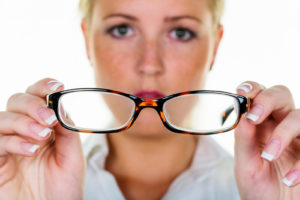
In some cases, corrective lenses are, of course, necessary to see clearly. But here’s the kicker: almost all refractive errors can be improved through proper diet and vision therapy. Before we discuss how to fix refractive errors naturally, we first need to understand what they are and what causes them.
Myopia
Myopia, more commonly known as nearsightedness, is one of the most common types of refractive errors. When a person is nearsighted, objects close to the eye will appear clear, but objects at a distance will be blurry.
This refractive error is often caused by abnormalities in the lens of the eye, the cornea, and the length of the eyeball. In a myopic eye, the eyeball itself is typically too long, the lens is too thick, and the cornea is too curved. Though myopia can be caused by any one of these conditions, it is often due to a mix of the three.
A person with myopia will likely have no trouble reading this article without glasses. However, seeing something on a TV screen across the room will prove more difficult. And, it’s important to note that usually, a person’s eyeballs are not exactly the same. So, if you are looking to fix this refractive error, your doctor will likely need to prescribe you different lenses for each eye.
So why does the shape of the eye, thickness of the lens, or shape of the cornea impact your vision? Well, each of these issues prevents light from reflecting on your retina properly. It often reflects just in front of the retina rather than directly on it.
Who’s at Risk of Myopia?
If you’re over the age of 18 and haven’t yet been diagnosed with myopia, you’re in luck. Myopia typically begins in childhood. The eyes develop the symptoms of myopia as they grow. This also means that sometimes, children grow out of myopia as their eyeball catches up to the size of their cornea, or vice versa.
That being said, it isn’t always, or even usually, the case. Research shows that instances of childhood myopia are actually on the rise, especially as kids spend more and more time on screens. This is why it’s especially important to limit your child’s screen time and make sure they get outside regularly!
Hyperopia
Hyperopia, otherwise known as farsightedness, is myopia’s cousin refractive error. When someone is farsighted, it means that objects in the distance, like the TV screen or whiteboard, appear clear, while objects close to the eye, like your phone screen or book, are difficult to see.
However, hyperopia can affect individuals in vastly different ways. While some will experience drastic differences in sight when looking at objects in the distance versus objects up close, others will hardly see a difference. This leads to many people not knowing that they are farsighted.
Some people with hyperopia may also have overall blurred vision. This means that both up-close and far-away objects appear blurry, but those objects far away are slightly less so. Because of this, it can be difficult to tell on your own if you have hyperopia. This is why it’s so important to keep up with regular eye exams so that your doctor can help you notice any changes to your eyesight.
So what causes this refractive error? Exceptionally short eyeballs are the main culprit in hyperopia. As a result, light refracts behind the retina as opposed to in front of the retina (myopia) or directly on the retina (regular vision).
Who’s at Risk of Hyperopia?
While this condition can affect children and adults, those most at risk are people whose parents have hyperopia. Genetics don’t always cause hyperopia, but the chances of a child being born with the condition are heightened when one or both of the parents have hyperopia.
Hyperopia is the result of the cornea and the lens being misshapen; however, a shortened eyeball is not always to blame. An eye injury can also cause the eye to become misshapen permanently and leave a previously unaffected eye with a refractive error.
Astigmatism
Astigmatism is a refractive error that refers to the irregular curvature of the cornea. Often, astigmatism is present along with myopia or hyperopia, but people can also experience this refractive error on its own.
The main difference between astigmatism, myopia, and hyperopia is that astigmatism is not caused by the size of the eyeball. Most people with astigmatism are born with a typically sized eyeball, but an irregular cornea.
That irregularity can present itself in various forms. A cornea that is curved too much or too little causes astigmatism. However, abnormal curving is not always the culprit. Sometimes, the cornea develops bumps instead, which will also cause astigmatism.
When light refracts through an irregular cornea, the light on the retina is unfocused, causing blurred vision all around. So, for the astigmatic eye, both near and distant objects will appear blurry.
Who’s at Risk of Astigmatism?
It is hard to really pinpoint who is at risk of having astigmatism. In most cases, people are born with astigmatism to parents who don’t necessarily have the condition. Researchers have pinpointed a variety of causes for astigmatism, but none of them are necessarily hereditary.
However, we do know that astigmatism can also be caused by an eye disease that alters the shape of the cornea or an eye injury.
Presbyopia
And now for our final refractive error: presbyopia. Unlike the previously mentioned refractive errors, presbyopia will impact almost everyone as we get older.
Here’s where things get a little tricky. Presbyopia is technically a type of hyperopia, because for a presbyopic eye, distant objects will appear clear while near objects will not. However, presbyopia is not caused by an irregularly shaped eyeball. Instead, it develops when the lens begins to lose its elasticity.
Though there are ways to put off developing presbyopia by keeping your eyes strong, the lens will eventually wear out. This is a normal part of aging. Typically, the lens begins to lose its elasticity around the age of 40, but it can begin as early as 35 if you don’t take proper care of your eyes.
Who’s at Risk of Presbyopia?
Everyone! But that doesn’t mean that you have to submit to this condition. Strengthening your eyes through diet and exercise, and seeing your eye doctor once a year, can keep your eyes stronger for longer.
Vision Therapy for Refractive Errors
Most of the time, physicians correct refractive errors using eyeglasses. That’s a great solution if you’re looking for a temporary fix. However, for those looking to improve their vision naturally and possibly even eliminate the need for corrective lenses, vision therapy could be a good option.
Vision therapy is an individualized type of therapy that consists of regular doctor-led sessions coupled with at-home eye exercises. Doctors tailor vision therapy to fit your specific needs, making it a great option to fix refractive errors. If you’re working with the right professional, you won’t receive a generalized regimen.
Refractive errors can have a negative impact on anyone’s life. Understanding the types and symptoms can certainly help us have a starting point for treating an uncorrected refractive error. However, vision therapy can help to improve your sight and your eye strength for healthy eyes. Add a thorough regimen plus some eye-healthy vitamins to your daily routine, and you will hopefully see some big improvements in your vision.



thanks for the sensitization. I need more explanations and how do I get the drugs and the medicated eyeglass, and its cost implication?
How does one find vision therapy?
I am in Durham/Chapel HIll, nc area
I have a droopy eye lid ,Some days worse then others ,is there a exercise for this problem? Or a diet !
I’m suffering from myopia… From last 2 years… Plzz send me to any solution to correct my vision Naturally and physically.. I don’t want to wear glass on my eyes