

How to Improve Farsightedness Naturally
There is a large variety of vision-related disabilities. One of the most prevalent forms of vision problems is hyperopia, more commonly known as farsightedness. Learning how to improve farsightedness naturally can help those with eye-related issues maintain their vision.
Those inflicted with farsightedness usually have no trouble seeing objects at a distance but have issues when trying to focus on objects that are up close. Farsightedness is often confused with presbyopia, also known as old-age sight, which also causes blurriness when trying to focus on up-close objects.
Someone suffering from farsightedness could be at the mercy of eye-related problems when trying to see objects or text up close. Everyday activities, such as reading or working on the computer, can cause strain and fatigue. Learning how to improve farsightedness naturally can help relieve these painful symptoms.
You can potentially reverse hyperopia depending on several factors. It’s important to try several stimulus and exercise-based therapies and measure the results so you can be sure that these particular eye exercises are right for you. Reading glasses can provide good results, but it’s important to stimulate your eyes to not become dependent on corrective prescription solutions.
What Are Some Symptoms of Farsightedness?
Farsightedness happens when the light entering the eye is focused behind the retina, rather than directly on it, causing the image to be out of focus. Living with a condition such as farsightedness can be difficult, and dangerous and can reduce a person’s overall quality of life.
 Signs of hyperopia, or farsightedness, are obvious when a person is trying to focus on objects up close. Symptoms mainly include blurry vision when trying to focus on something that is in your near field of vision.
It’s common for people to overexert their eyes by trying to focus on objects up close. This overexertion can lead to eye strain and headaches. Red eyes, frown lines, and wrinkles are some other mild issues that can stem from straining and squinting your eyes.
How Does Someone Develop Farsightedness?
Many people are diagnosed with farsightedness at an early age, due to the eye not growing at the same rate as the rest of the body. Many children also inherit farsightedness from their families, though more often than not, people outgrow inherited farsightedness.
When you suffer from farsightedness, your eyes don’t receive light in the same way that a “normal” eye would. Due to the eye’s smaller size, the incoming light is focused on the wrong part of the eye, missing the lens, which is what focuses the image for your brain. This creates that blurry effect that is common among farsighted people.
Farsightedness can also be the result of poor eye care and bad habits, such as improperly using magnifying glasses, as this can cause the user to lose connection with their focusing muscles.
How to Improve Farsightedness Naturally
Maintaining a healthy lifestyle requires maintaining your vision. Using training techniques and eye exercises will help you improve and keep your eyes and vision healthy.
Strengthen Eye Muscles
This first exercise works out the elasticity of your eye muscles, which is important for bending your lens and is needed for your eye to properly focus light:
- Move your eyes all the way to the left, and try to see your ear and hold it. After a moment, do the same on the right.
- While keeping your head straight, point your eyes diagonally, both up and down. Look at your eyebrow when you’re looking up, and your shoulder when you’re looking down.
- Start moving your eyes all the way up, while keeping your body still and pointed straight. Turn your eyes and look all the way down at your feet. Hold it there for a moment.
- Repeat all the steps several times.
- Finish your exercise by rolling your eyes in a complete circle. Try to remove any stress and tension from your eyes and facial muscles.
Try this exercise twice a day, once when you wake up and once before you go to bed.
Thumb Rotations
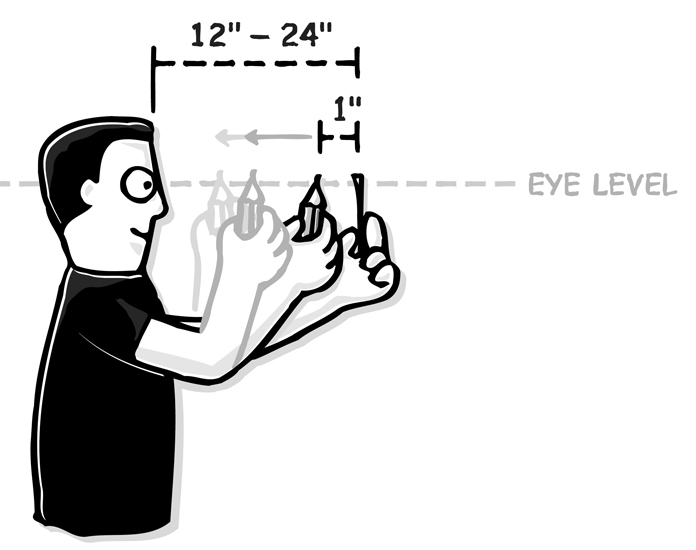
There are many other popular eye-training exercises to help deal with farsightedness. Here is another common training exercise, using your thumb:
- Close one eye, and cover it with your hand.
- Reaching as far as you can, extend the opposite hand out in front of you.
- On the extended hand, make a fist and point your thumb upwards.
- Focus your vision and attention on your thumb, while slowly moving your arm around in circles.
- While tracking your thumb, slowly move your arm around three times in each direction.
- Start to move your entire body, while tracking your thumb.
- Slowly take the hand that’s covering your eye away, and pay attention to the difference between your eyes.
Thumb rotations help develop your eyes and improve awareness which helps your visual abilities. Maintaining good vision requires a healthy eye-training routine, so make sure that you remember to do your exercises every day.
More Vision Improvement Tips
Many people find that improving their diet can have a direct cause on improving their farsightedness. There are vitamins and antioxidants that can help improve eyesight naturally and can be found in common foods.
Vitamin A is often associated with eye health, so make sure to include foods like carrots and zucchini in your daily diet. Some oils, like cod liver oil, also provide a beneficial amount of vitamin A.
Lutein is also known to help improve farsightedness, and supplementation should be considered when learning how to improve farsightedness naturally. You can find this antioxidant in various fruits and vegetables, such as kale and spinach.
Living a healthy lifestyle requires keeping up with good habits. You need to be proactive in training and exercising your eyes and muscles so that you can continue to live a safe and healthy life. Even the easiest of everyday tasks can become unmanageable when you suffer from poor vision. Farsightedness may be a common eye problem, but there are ways to prevent and treat it. You just have to find the routine that works for you and stick to it!



Comment