Sign Up Now For 10 Ways To Improve Your Vision Naturally

Here are just a few things you will learn:

  • How To Improve Your Eyesight By Not Wearing Glasses Or Contacts.
  • 11 Vision-Boosting Super Nutrients No One Talks About.
  • Why Aging Is Inevitable But Losing Your Eyesight Is Not.
  • Try This Easy Eye Exercise For Better Vision.

Children’s Eye Health

Eye care isn’t just for adults. In fact, maintaining your children’s eye health is critical, because a child’s visual development reaches maturity between the ages of 9 and 11. Early diagnosis can mean the difference between normal vision and a permanently “lazy” eye.

But would you know if your child had a problem with his sight?

Unfortunately, children often accept their vision problems as normal because they simply don’t know better or cannot find the words to communicate what is occurring. And very often kids with vision problems are mislabeled as having a learning disability.

But now is the perfect time to take a closer look at your child’s sight.

Look Smart

The kids have been back in school for a few months. There’s the usual grumbling about too much homework and who gets to sit in the chair closest to the TV. You may be tempted to dismiss these behaviors as childish complaints, but they may hold important clues about potential vision problems. Although teachers are oftentimes the first to notice students’ vision changes, concerned parents will want to be on the alert for the following signs that their child’s sight may need correction:

  • Consistently sitting too close to the TV or holding a book too close
  • Losing his or her place while reading
  • Using a finger to follow along while reading
  • Squinting
  • Tilting the head to see better
  • Frequent eye rubbing
  • Sensitivity to light
  • Excessive tearing
  • Closing one eye to read, watch TV, or see better
  • Avoiding activities which require near vision, such as reading or homework, or distance vision, such as participating in sports or other recreational activities
  • Complaining of headaches or tired eyes
  • Complaining that computer use hurts the eyes
  • Receiving lower grades than usual

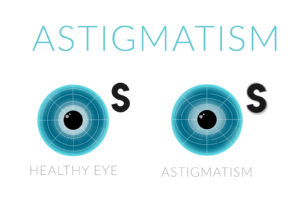
According to Prevent Blindness America, vision problems affect one in four school-age children. Refractive errors like myopia (nearsightedness), hyperopia (farsightedness), and astigmatism (blurriness caused by an irregularly shaped cornea) are the main concerns for school-age children.

Other Eye Problems

Strabismus (crossed eyes) and amblyopia (lazy eye) also develop in a child’s early years. Early detection is crucial to the development of normal vision. Strabismus is a condition in which both eyes cannot align simultaneously. One or both of the eyes may turn in, out, up, or down. Strabismus can be inherited or caused by an injury to the muscles or nerves of the eye, or even problems in the brain. (No, the old wives’ tale is not true: If you deliberately cross your eyes, they won’t stay that way.)

It is estimated that up to 5 percent of all children have some type or degree of strabismus. Strabismus cannot be outgrown, nor will it improve by itself; treatment may include glasses, eye drops, eye exercises, or even surgery.

Amblyopia is a dimness of sight, especially in one eye, without apparent change in the eye structures. Most often it results from either a misalignment of a child’s eyes, such as crossed eyes, or a difference in image quality between the two eyes (one eye focusing better than the other.)

In both cases, one eye becomes stronger: If this condition persists, the weaker eye may become useless. After the underlying cause of the condition is treated (for example, glasses are commonly prescribed to improve focusing or misalignment of the eyes), the child will need to use the weaker eye most of the time, so it will get stronger.

To make the child use the weaker eye, a patch can be put over the stronger eye. Or conversely, eye drops or special glasses are used to blur the vision in the stronger eye in order to strengthen the weaker one.

When it comes to a child’s eyesight, an ounce of prevention is worth a pound of cure. A few simple tips and habits from the Rebuild Your Vision Program could mean a world of difference in the progression of vision problems.

About Orlin Sorensen

Orlin Sorensen, founder of Rebuild Your Vision and author of the best-selling program, wore corrective lenses for years beginning in his teens. Through the use of vision training, he improved his vision from 20/85 to 20/20 and was able to pass the visual acuity test given to U.S. Navy fighter pilots. Men's Health declared this one of the "Greatest Comebacks of All Time," and since then Orlin has dedicated himself to sharing the knowledge which has helped thousands of people improve their vision naturally.

No comments yet... Be the first to leave a reply!

Leave a Reply